


Initiative Reform
Fair Initiatives in the District
The District’s restaurant industry is an industry of opportunity — one of the few sectors where someone can start as a server or bartender and earn well above DC’s minimum wage through tips alone, often while building toward a management or ownership career. That opportunity is only possible when the policies governing the industry are shaped through deliberation amongst our elected councilmembers — not an outsider-funded signature drive.
DC’s ballot initiative process lacks the basic guardrails most states have built in:
- There is no single-subject rule to prevent unrelated policies from being bundled together.
- There is no requirement for a fiscal impact statement before signatures are gathered.
- Legal objection periods can last as little as five days, leaving minimal time for public review.
These gaps have made the District an easy target for outside groups to advance their agendas. Initiative 82, which proposed to phase out the tip credit, was funded almost entirely by a single organization. Initiative 83 was bankrolled by a group based in Colorado that contributed more than $553,000. Measures marketed as grassroots campaigns often are not.
Now, Initiative 87 seeks to dramatically reshape the District’s wage laws by increasing the citywide minimum wage to $25 per hour by July 2029, eliminating the tipped wage entirely by July 2031, and restricts who service charges can go to. These sweeping changes would affect every restaurant in the District and underscore why complex labor policy deserved the legislative process — not a “yes” or “no” ballot question.
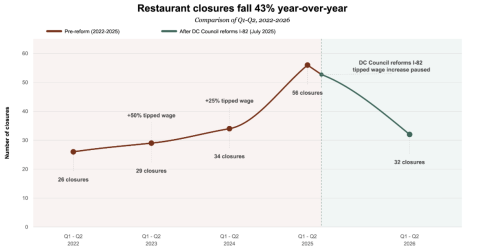
Information sourced from the Restaurant Association of Metropolitan Washington
DC restaurants just lived through something policymakers rarely get: a clear before-and-after look at what a major wage policy change does to the industry. For three straight years after Initiative 82 passed, restaurant closures soared. Then, within months of the DC Council correcting course last July, mid-priced restaurant closures dropped 54% year-over-year in the first two quarters of 2026, driving a 43% citywide decline for all restaurant types.
These results are evidence that Initiative 82 was a failed experiment — and proof that, with Initiative 87 potentially reaching the ballot box, DC can't afford to run another one. DC already pays the highest minimum wage of any state in the country, rising automatically each year with inflation, and restaurants are still being squeezed from multiple angles.
Other jurisdictions have shown that citizen lawmaking can still exist and be meaningful with real guardrails. Massachusetts provides a clear example. For more than a century, the Commonwealth has run an indirect initiative process. A campaign cannot simply collect signatures and go straight to voters. Every qualifying measure moves through legal review and the state legislature first, but voters still get the final word. In the Massachusetts model:
- Legal review comes first. Before a single signature is gathered, the Attorney General must certify that a proposal is a permissible subject for an initiative, complies with the state constitution and federal law, and addresses only one subject.
- Elected lawmakers get a formal opportunity to act. Every successful petition is referred to the legislature, which can enact the measure, negotiate revisions, or offer an alternative before the measure reaches the ballot. In the District, qualifying initiatives bypass the Council entirely, leaving no chance to clarify ambiguous language or address unintended consequences before a binding law takes effect.
- Public support has to be sustained, not just purchased once. Massachusetts requires two separate rounds of signature gathering — one to qualify, and a second after legislative review — so that a single well-funded signature drive is not enough to put a measure in front of voters. DC requires only one round
None of this shuts residents out of lawmaking. Massachusetts voters still decide on initiatives at the ballot box, and a simple majority still carries. What the process guarantees is that anything reaching the ballot has been screened for legality, narrowed to a single subject, and put in front of elected representatives. Strengthening oversight does not weaken direct democracy — it makes the result more legitimate and likely to last.
Timing matters as much as process. A measure voted on in a special election is decided by a small sliver of the city. A citywide special election is expected in spring 2027 to fill the At-Large Council seat left vacant after Robert White secured the Democratic nomination for DC Delegate. Turnout in District special elections is consistently low. The two most recent citywide special elections drew 10.36% of registered voters in 2011 and 11.32% in 2013 — roughly one-third of primary turnout and one-seventh of general election turnout.
That is a weak gauge of how District voters actually feel — particularly for a policy that would reshape wages at every restaurant in the city. Initiatives that create binding law belong on ballots where the full electorate shows up, not on one that fewer than one in ten registered voters will cast.
That’s why RAMW supports the Fair Initiatives Act (B26-0436), which would require fiscal impact statements before signature gathering, limit each measure to a single subject, extend legal review and public objection periods, require petition circulators to disclose whether they are paid and have DC residence, and expand opportunities for public comment. DC voters deserve the same level of transparency and scrutiny for ballot initiatives that every bill before the Council already receives.

Join RAMW
Membership in the RAMW links your company with thousands of metropolitan Washington foodservice operators, customers, and programs.